Conditions to sustain attention in work that requires depth.
Sound Performance for Productivity
Was your office designed for what people actually do in it?
Focus, collaboration and well-being in the workplace.
Sound Performance for Productivity
Focus, collaboration and well-being in the workplace.
Dissonance
Architecture, lighting, air conditioning and furniture are all designed and specified. Sound almost never is. And it shows up in scenes everyone recognizes:
The theme
Different people carry out different activities. Each activity needs its own sound conditions.
When those needs meet in the same space without direction, the result is conflict: concentration interrupted, conversation inhibited, privacy exposed.
Modulation
Research on the workplace is consistent on a few points. Intelligible speech from other people is one of the main sources of distraction. Frequent interruptions increase the effort required to stay with the work. And excessive silence does not solve the problem: it makes every conversation audible to everyone and leads people to avoid speaking.
That is why the goal is never to create silent environments. It is to create sonically intelligent ones.
Resolution
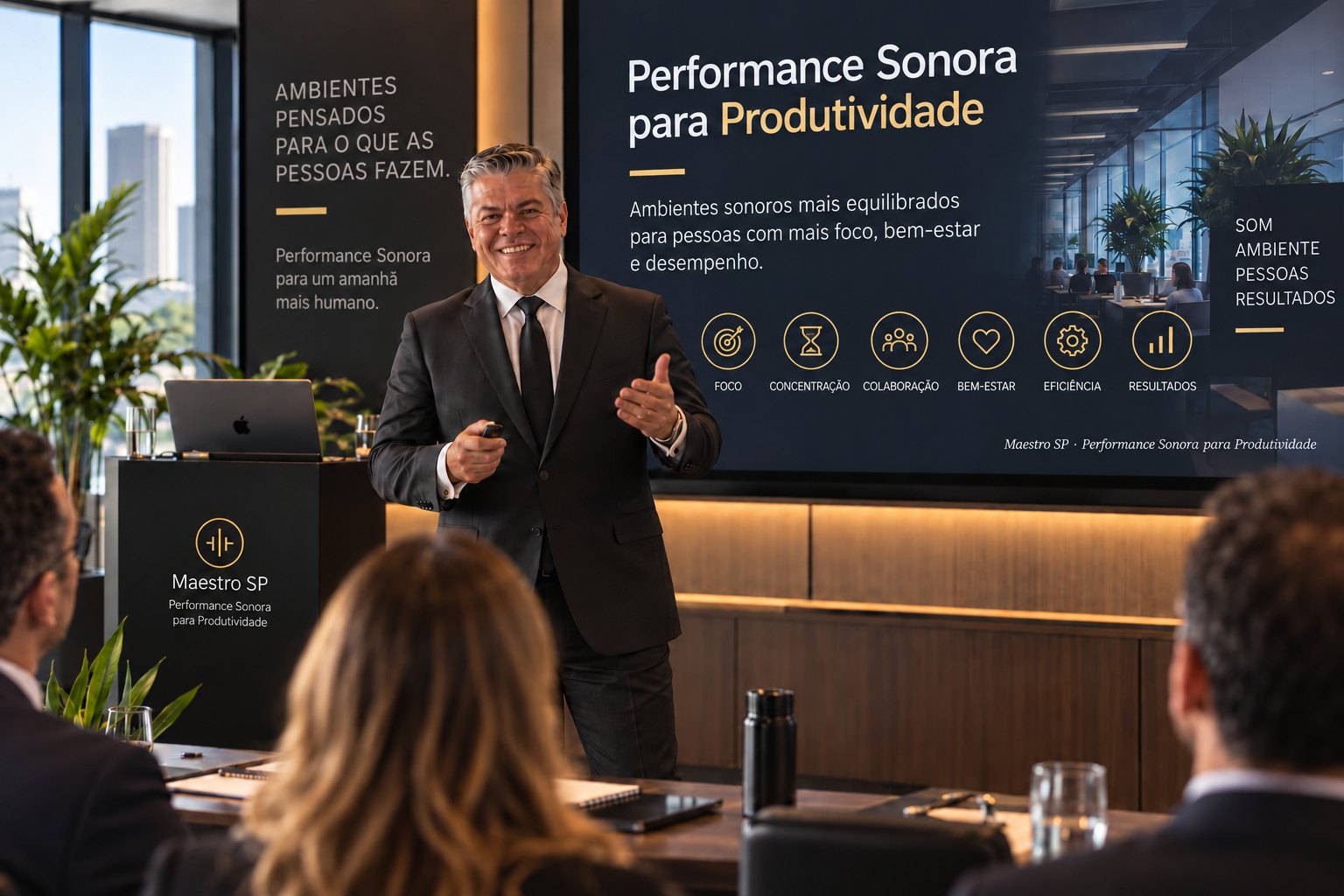
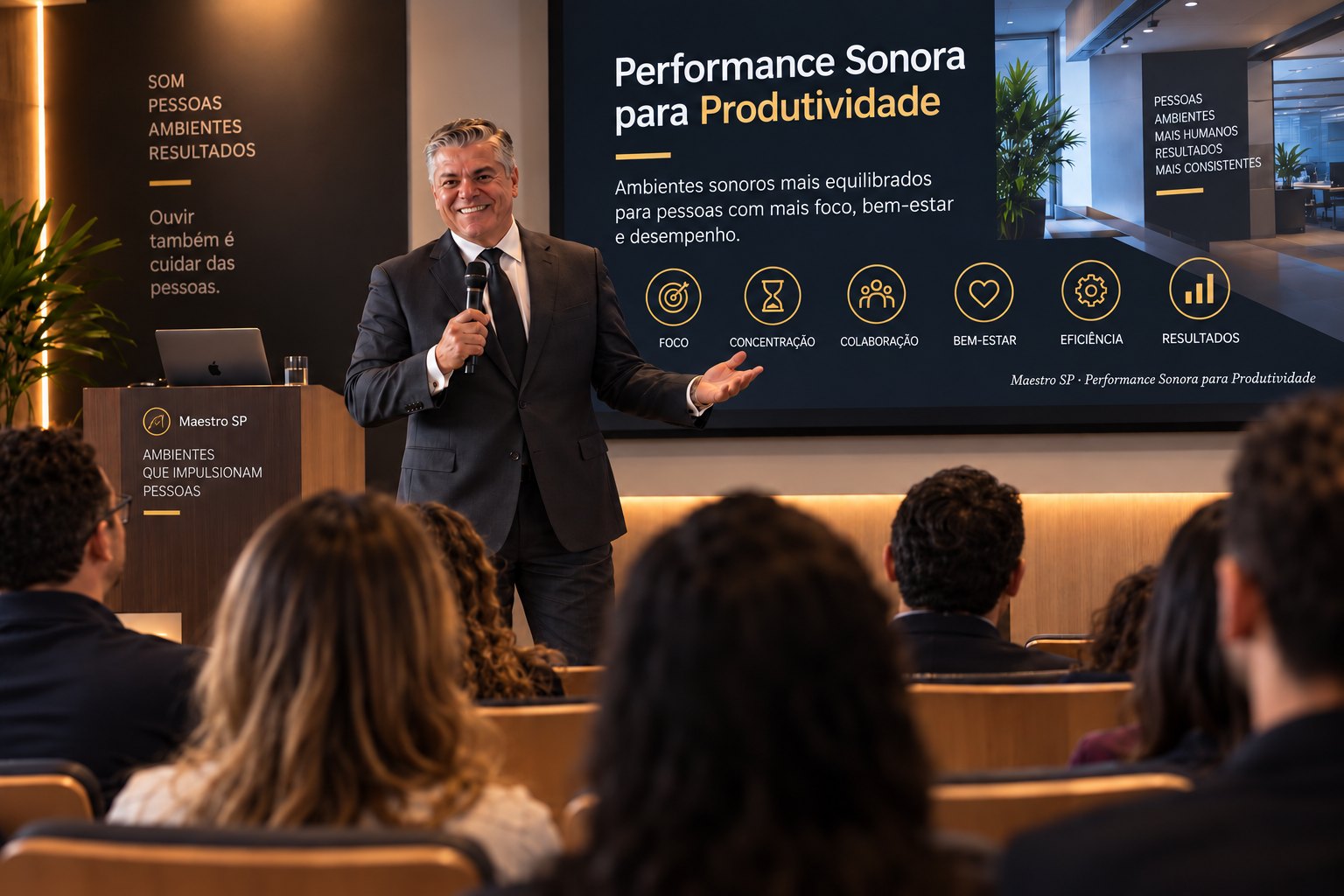
Sound Performance for Productivity is the Maestro SP discipline that understands and conducts the relationship between work activities and the sound environment in which they take place.
We start from activities, not from decibels. Before measuring the space, we understand what people do, where and when.
We work on five fronts: use of space, organization of time, shared agreements, technology and — when necessary — physical intervention, always carried out by licensed professionals.
We follow the environment over time. It changes, and the conducting changes with it.
Pillars
Conditions to sustain attention in work that requires depth.
Fewer involuntary interruptions throughout the day.
Talking and deciding without inhibiting those who need to concentrate.
Sound conditions suited to the activity and to the time people spend there.
Less effort to communicate, understand and return to the work.
Decisions about the environment supported by a technical reading, not by improvisation.
How the work unfolds
A conversation with leadership, a guided visit of up to 90 minutes and a report with the reading of activities, the likely sound conflicts and the recommended next step.
A deeper study of the environment and the activities, with an anonymous and voluntary questionnaire and, when required, measurement carried out and signed by a licensed engineering partner.
Definition of the parameters for use of space, organization of time, shared agreements, technology and — when necessary — physical intervention.
Support throughout the agreed actions, with physical work carried out by licensed professionals.
Recalibration over time, because teams, activities and the space itself change.
Who it is for
What we are not
Sound Performance for Productivity is not acoustic treatment, it is not an occupational health and safety service and it is not legal consulting.
We work alongside architects, engineers, ergonomists and health and safety teams, providing the reading of the sound environment that supports their work.
Coda — begin by listening
A conversation with leadership, a guided visit of up to 90 minutes and a report with the reading of activities, the likely sound conflicts and the recommended next step.
Deducted from the Diagnosis if contracted within 60 days.
Read first: why a noisy office is not only a question of acoustics
Listening before deciding
A reading of the sound environment organizes a conversation that usually happens through scattered impressions — and gives leadership a common basis for deciding about the space.
Frequently asked questions
No. We start from what people do. Many improvements concern the use of space, time and shared agreements. When construction work is required, it is designed and carried out by licensed professionals, based on the parameters we define.
When the diagnosis requires technical measurement, it is carried out and signed by a licensed engineering partner and integrated into our reading.
Never. The diagnosis observes the environment and the activities, with an anonymous and voluntary questionnaire. No information is used to assess individuals.
No. We provide evidence about the sound environment that may support the professionals responsible, without replacing their work.
Yes. We serve environments from around 20 workstations in the city of São Paulo.
Yes. The Sound Performance Design Opinion examines the planned activities and the layout before construction, together with the architect.
Sound Performance for Productivity is a discipline for managing the sound environment. Its services do not constitute ergonomic analysis, occupational exposure assessment, technical expert reports, risk management programs, psychological assessment, acoustic design or legal advice, and they do not certify compliance with any standard.
Next step
Begin with the Executive Review, or present new premises still under design.
Productivity is heard, too.