
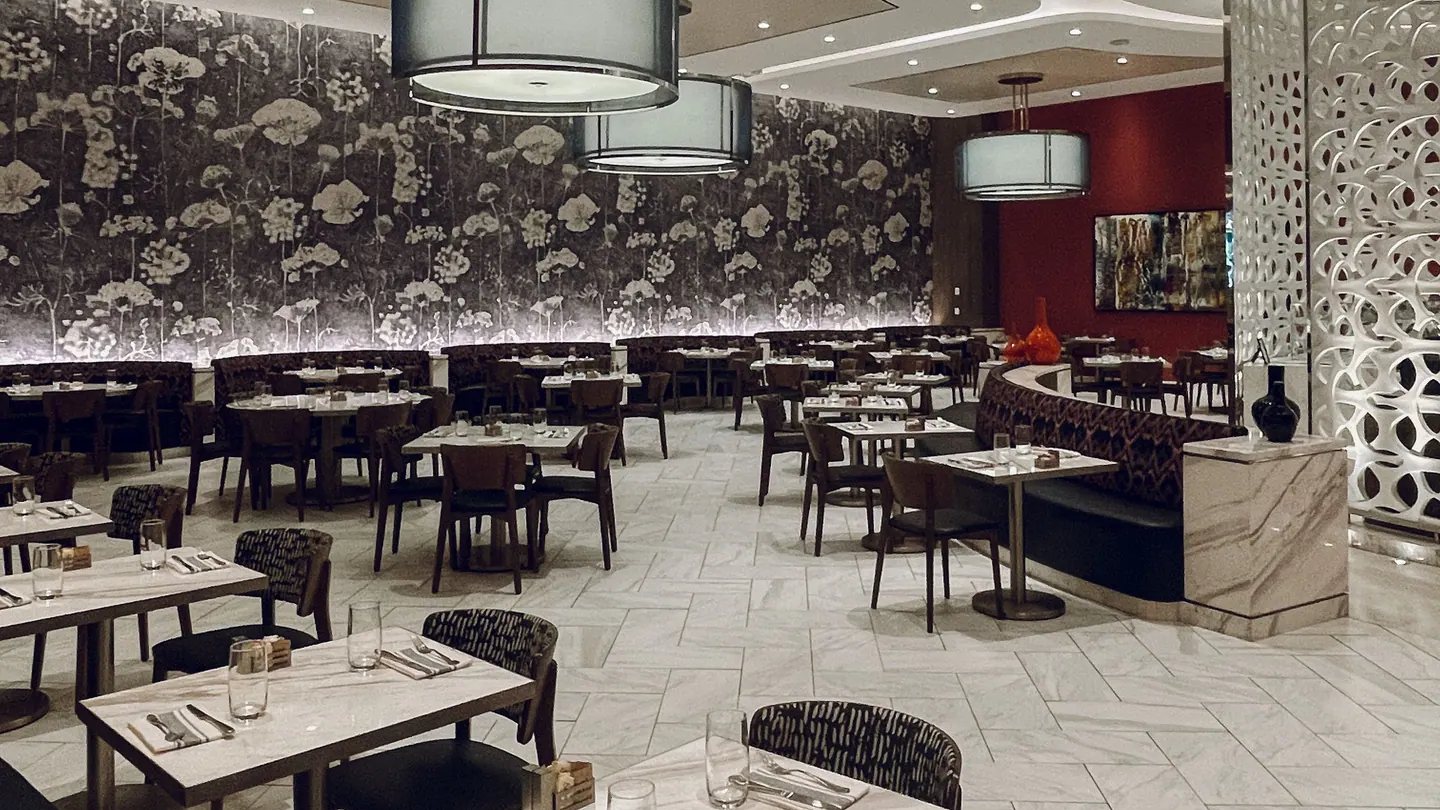
When a guest describes a restaurant as noisy, it is common to assume the problem lies only in the acoustics of the space. Hard surfaces, ceiling height, reflective materials and the absence of absorbing elements can indeed contribute to discomfort. On their own, however, they do not explain everything the guest hears during the experience.
The sound environment of a restaurant is dynamic. It changes with the time of day, the number of people, the equipment in use, street traffic, the music, the service and the routine of the operation itself.
Understanding a noisy restaurant therefore requires a broader reading. Looking for a single source, or measuring a single moment, is not enough. It is necessary to observe how different elements act simultaneously and form what Maestro SP calls the sound resultant of the space.
Guests do not perceive sources in isolation
A guest does not walk into a restaurant assessing traffic, ventilation, the ice machine, the music, the conversations and the reverberation separately. They perceive the result of all of it happening at the same time.
A source that seems acceptable on its own may become relevant once added to the others. In the same way, music at an apparently moderate level may lose clarity, or demand more communication effort, when ventilation, equipment and voices already occupy the sound environment.
Instead of asking only “which piece of equipment is making noise?”, the investigation considers how the different sources combine during operation, and what the guest perceives as a result.
Noise can start outside
Not every noise perceived inside a restaurant is produced by its operation. Traffic, horns, buses, motorcycles, construction, pedestrian flow and neighbouring businesses can enter through façades, doors, windows and open areas.
External influence also varies through the day. A space may feel comfortable during preparation and present a different condition at peak traffic hours. Closing a door or a window may reduce part of that influence, but it may also change ventilation, climate control and circulation — showing how an apparently simple decision affects other components of the operation.
Ventilation, extraction and climate control are part of the sound
Fans, extractors, ducts and air conditioning systems stay active for long periods and can form a continuous sound layer. Because these sounds are relatively constant, they do not always draw the attention of those who work in the space every day. For the guest, however, that layer is present from arrival.
Beyond the sound produced directly by the equipment, there may be vibration, air turbulence, mechanical looseness and structure-borne transmission. This does not mean every ventilation system is a problem: it means the system must be part of an integrated reading of the space.
Equipment and routines add further layers
Refrigeration, ice machines, blenders, utensils, crockery, doors, furniture and service systems also take part in the sound experience. Some sounds are brief and intense, others are continuous, and some appear only at particular moments of the operation.
The challenge is not to eliminate all operational sound — a restaurant has to work. The point is to identify which sounds are coherent with the intended experience and which begin to compete with comfort and conversation.
Music and sound systems do not act alone
Music is often the first element adjusted when a space feels noisy. Lowering the volume, however, may not resolve the perceived cause if other sources remain dominant. Equally, raising the volume to make the music more present may increase competition with conversation and equipment.
The musical experience depends on more than volume. It involves speaker distribution, coverage, balance, repertoire, the dynamics of the content, and the relationship with a space already occupied by other sources.
Occupancy transforms the space in real time
An empty restaurant does not present the same sound condition as a restaurant in full operation. As guests arrive, conversation, movement, service, utensils and different behaviours appear.
In noisy environments people involuntarily tend to increase vocal effort in order to be understood. This behaviour is known as the Lombard effect. It does not mean voices are the only cause of the problem: it demonstrates precisely that environment, occupancy and behaviour interact.
Why treating acoustics alone may not be enough
Acoustics is fundamental to understanding a noisy restaurant. It influences propagation, reflection and how sound energy persists in the space. But an exclusively acoustic intervention may fall short when it does not account for external sources, ventilation and extraction, equipment, sound systems, occupancy, service routines, critical hours and operational decisions.
This is not a choice between acoustics and operations. It is a matter of understanding how they relate.